· Jonas Entrup · Packaging
Paper and cardboard packaging machines: 90% feasible in industrial production
What “90% feasible” actually means in an industrial context
We are talking exclusively about packaging made of paper and cardboard.
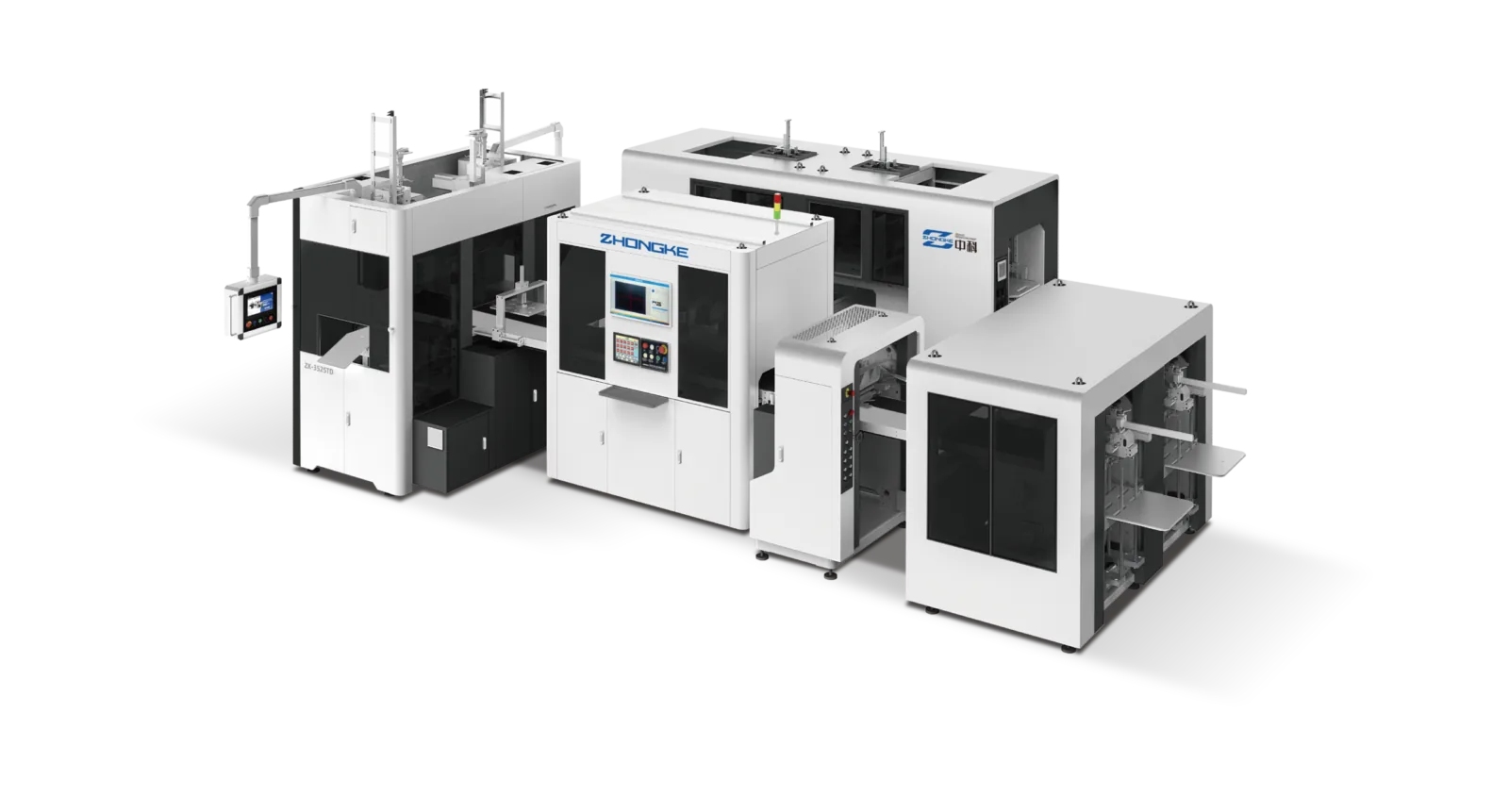
The Zhongke portfolio allows for the economical production of around 90% of common industrial paper and cardboard packaging types – typical for series applications and depending on the specification, format window and material quality.
This statement does not refer to the entire packaging market. It clearly refers to industrial applications in the paper and cardboard segment.
The difference is crucial.
Technical operating range
In everyday industrial practice, this cover window typically includes:
Rigid box applications for electronics, cosmetics, premium products and high-quality consumer goods. Folding box and cardboard solutions for high-volume applications. Format window depending on the model, up to approximately 900 mm. Cardboard thicknesses in the rigid range are often between 0,8 and 3 mm. Grammages in the folding segment are typically between 250 and 450 g/m². Positioning accuracies for vision systems up to ±0,05 mm – depending on the machine configuration.
These values are model-dependent, but provide a realistic industrial framework.
However, the technical machine window is not the only decisive factor.
The difference between "machine-compatible" and "series-compatible"
Many projects fail not because of the plant's performance.
They fail because of:
- lack of interface clarity
- insufficiently defined quality criteria
- undocumented process parameters
- unstable line integration
- lack of knowledge transfer to operating personnel
In practice this means:
The pattern is convincing. The series is becoming unstable.
And instability comes at a cost. Not only through scrap, but also through downtime, discussions and declining confidence in the process.
Series production capability is a system-level issue
OEE (Overall Equipment Effectiveness) is not created by a single machine.
It is created by:
- stable material quality
- reproducible parameters
- clearly defined handovers
- documented SOPs
- coordinated interfaces such as OPC UA, Profinet or MES connection
Especially in Austrian production environments with high quality requirements, any process instability has an immediate impact.
Therefore, we do not view projects in isolation as machine purchases, but as system integration.
Technology combined with service structure
To ensure line and series production capability, we combine the machine portfolio with our own technical structure:
Structured commissioning with documented parameter base. Preventive and corrective maintenance. Regionally organised spare parts supply. Remote diagnostics for rapid root cause analysis. On-site support available if needed. Training and SOP development for change-stable, repeatable processes. Integration into existing line architectures and IT structures.
The goal is clearly defined:
Process consistency instead of just production output.
Validation model for new projects
To minimize risks during the start of series production, we proceed in a structured manner:
- Format analysis and material testing Testing of paper and cardboard quality, basis weight, coating and adhesive window.
- Reference layout and sample run Documentation of all relevant parameters.
- FAT and SAT logging Evaluation of cycle quality, bonding, positioning and quality assurance criteria.
- SOP finalization and training Handover to the production team with clearly defined process parameters.
- Serial release with defined checkpoints Ensuring reproducible setups.
The goal is not a good pattern. The goal is a robust, economical series.
Conclusion
Approximately 90% of common paper and cardboard packaging types can be technically and industrially reproduced – provided that specifications, material quality and process windows are taken into account.
The crucial question, however, is:
Is your solution also integrated for line and series production?
Frequently asked questions
What role does integration into existing lines play?
A key aspect. Integration with existing systems (e.g., via OPC UA, Profinet, or MES) significantly influences process consistency and transparency. Without seamless integration, even a technically powerful machine cannot be used to its full economic potential.
Does the 90% statement apply to all paper and cardboard qualities?
No. This statement refers to typical industrial applications with defined specifications. The crucial factors are basis weight, cardboard thickness, coating, and the specific processing window. Deviating materials or special formats must be technically tested and validated.
Where do the greatest cost risks arise in practice?
The primary issues are not machine performance, but rather a lack of line integration, unclearly defined interfaces, or undocumented process parameters. Instability in series production leads to scrap, downtime, and inefficient OEE.
How is series production capability technically ensured?
Through a structured validation process: format analysis, material testing, documented sample run, FAT and SAT logging, as well as SOP finalization and training of the production teams. The goal is repeatable and stable processes.
What types of packaging can typically be produced with Zhongke systems?
In an industrial context, around 90% of common paper- and cardboard-based packaging types can be realized – including rigid box series for electronics or cosmetics, as well as folding box applications in high-volume production. However, the actual feasibility depends on the available format, cardboard thickness, and material quality.